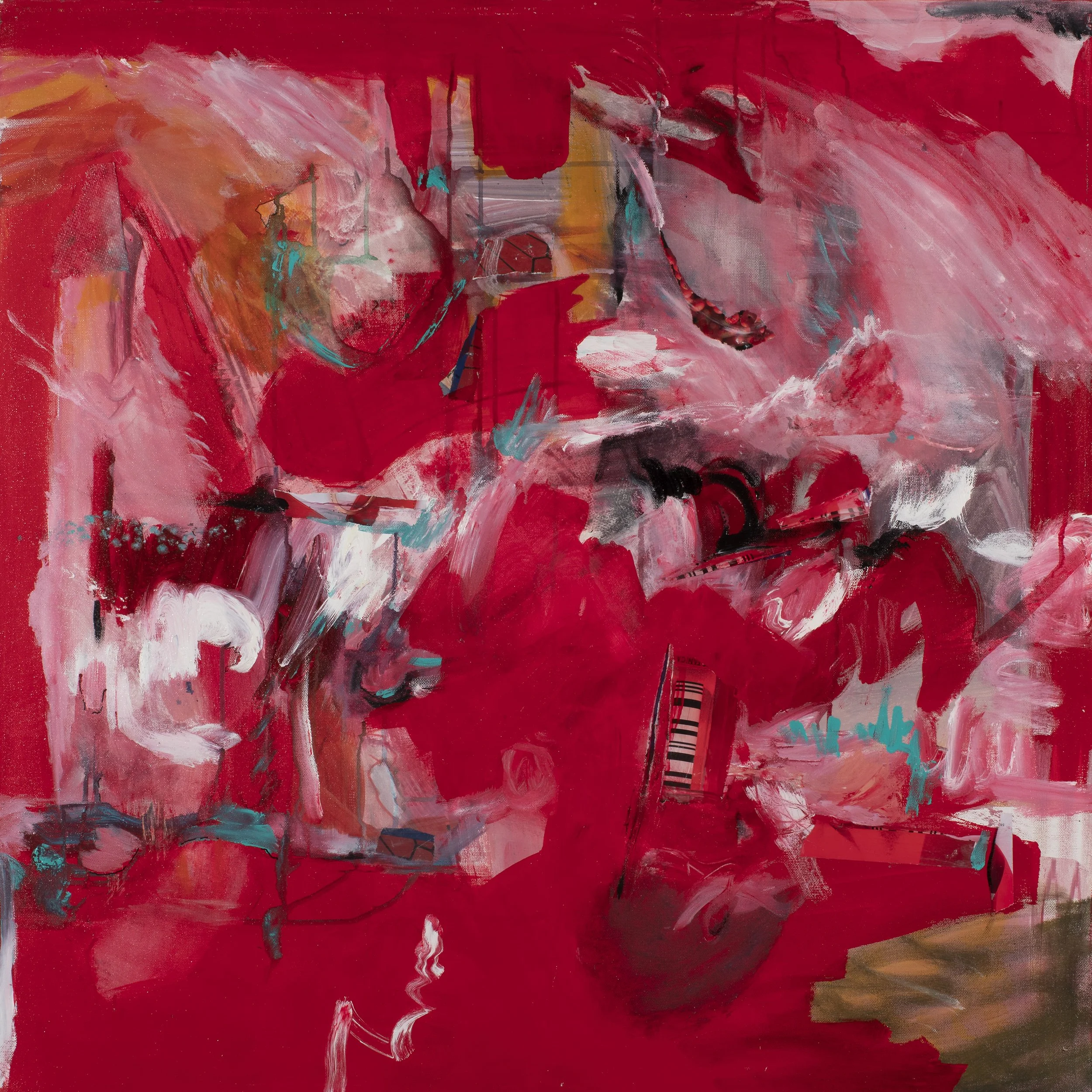
“I never cut, I only tear.”
Macchi has packed two lifetimes into her years, and that doesn’t even include her lifelong equestrian pursuits, which have ranged from classical dressage (still doing it) to years of barrel racing on the rodeo circuit (never broke a bone). After getting her painting BFA at Philadelphia’s Tyler School of Art Macchi went on to New York’s illustrious Art Students League, where her modernist teachers imparted a sense of shape (Knox Martin) and a feeling for the plasticity of paint (Peter Golfinopoulos). Scholarships took her to the historic Fine Arts Work Center in Cape Cod’s Provincetown, where she studied with painters Victor Candell and Leo Manso.
“One of collage’s masters,” per the pivotal abstract expressionist Robert Motherwell, Manso often subsumed his collage elements into the paint itself, applying color directly over and around them. Macchi’s work owes a debt to him. It’s full of scraps of paper and other two-dimensional materials, even glued-on chunks of dried paint from her palette, embedded within its surfaces. Her collage elements don’t just enliven the painting’s surface; they also influence how she paints around them. In one canvas that suggests a cantilevered bridge she uses a marker to extend the lines of magazine-scrap ladders through the horizon into the sky-blue of the painting’s upper half, making them part of the bridge’s superstructure. She is currently tearing up a set of letters from the 1940s that a friend donated to the cause. (“I never cut, I only tear.”) “They shouldn’t read as an isolated thing,” she says. “I want people to go up to the painting and take a closer look.” Yet stepping back again makes you realize how integral the collage elements are to the paint, and the painting.